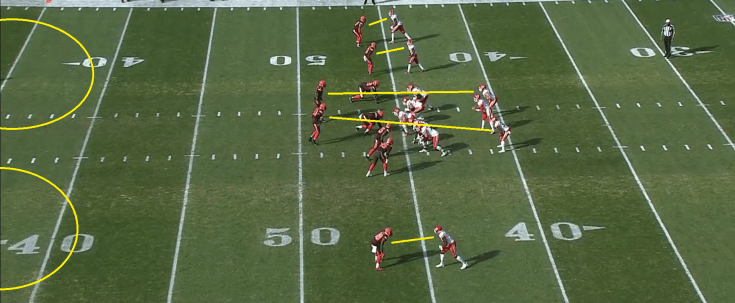
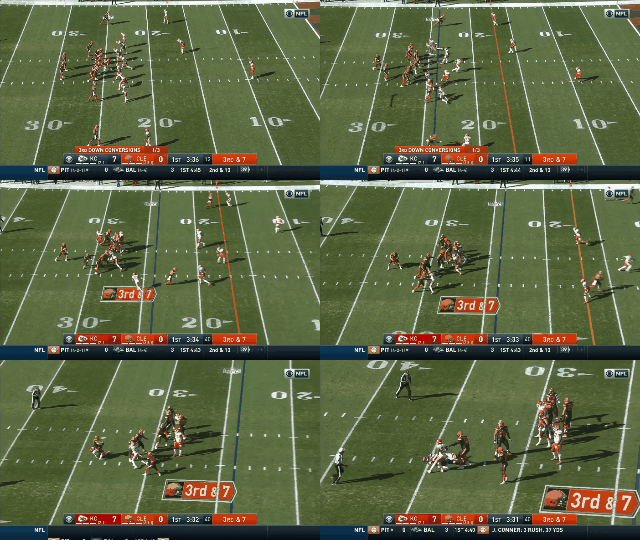
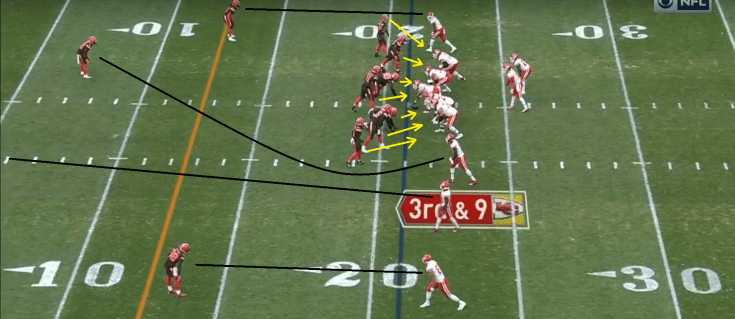
On this play, Kansas City is facing a 3rd and 20. Cleveland is playing cover 2 man, and not even trying to hide it. Their safeties are at the first down marker, and their other defensive backs are pressing on Kansas City’s receivers.
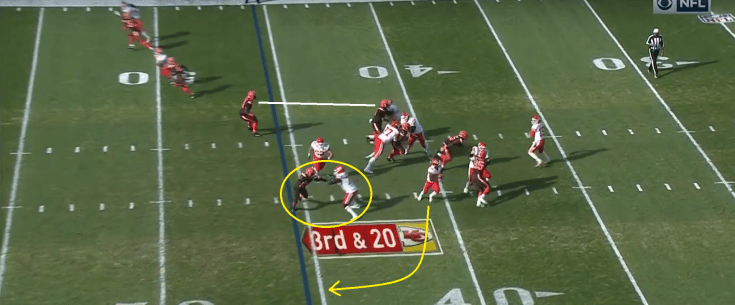
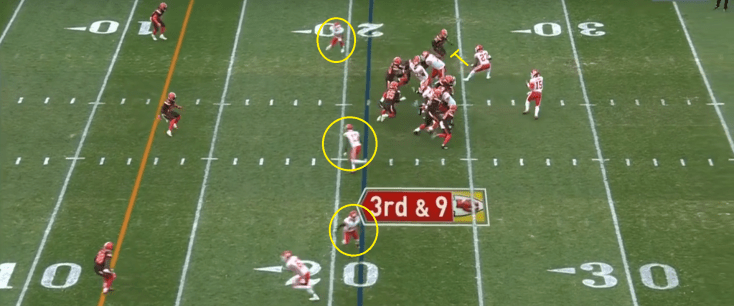
Since Kansas City knows what play Cleveland’s running, they can attack it pretty well. Here they’re going to run a screen pass. The key to this play is Chiefs left guard Cam Erving, who I’ve circled. He moves up and focuses on blocking the Brown who is assigned to guard Spencer Ware (Spencer Ware is Kansas City’s halfback on this play). This gives Ware plenty of room to run, and he’s good enough in open field to pick up a first down.
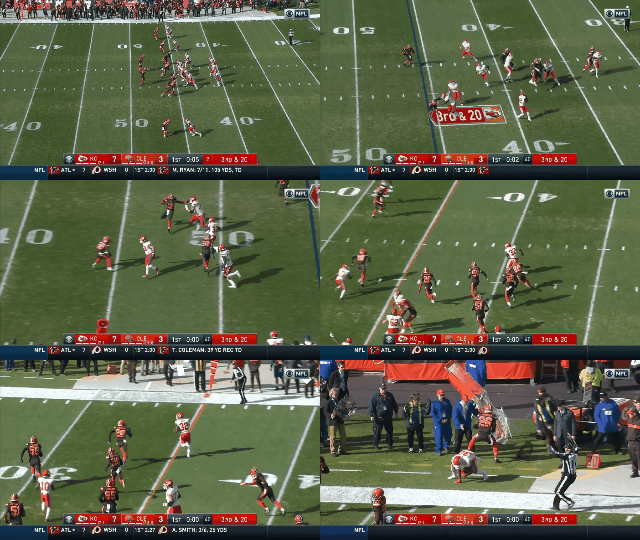
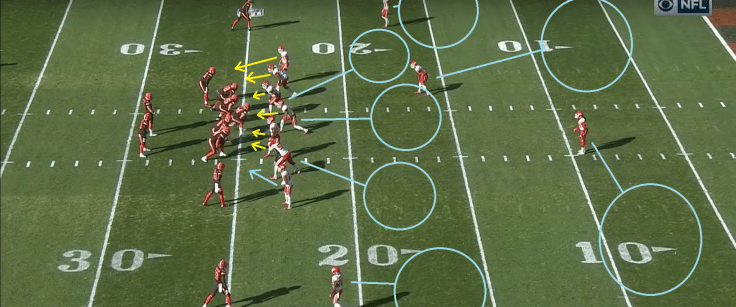
This is a pretty standard Cover 2 zone, however Kansas City has 7 guys on the line. So one of the first things Mayfield is going to want to look for is to see what Kansas City’s linebackers are doing. If they’re blitzing, Mayfield can throw it over the middle for a completion, if not, he’ll have to look at his other two receivers.
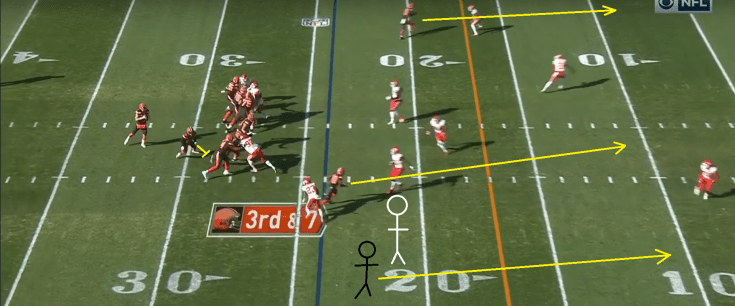
(Two players were off screen, however luckily I am an expert in digital animation, and was able to insert high quality graphics to serve as the players on the field.)
Since Kansas City’s not blitzing, and they’re playing zone instead of man, Cleveland’s going to have a receiver open at the top of the screen, Mayfield probably could’ve thrown it now, but he also thought he was going to have a little bit more time.
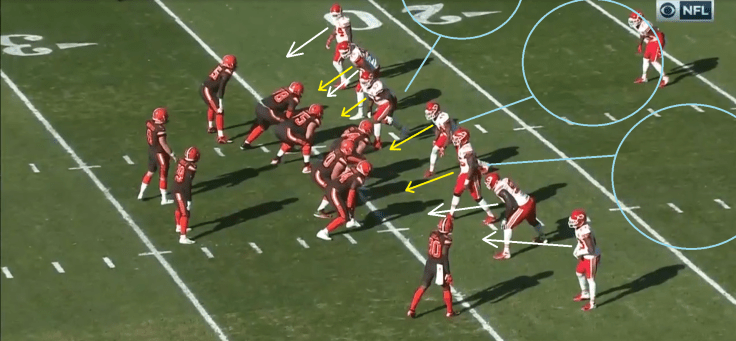
Typically in a cover 2 zone, a team would have 4 defensive linemen/linebackers rush the passer (the 4 who have yellow arrows). However in this play, The Chiefs are going to have 3 linemen drop back, and the four men rushing the quarterback are 2 linemen and 2 cornerbacks.
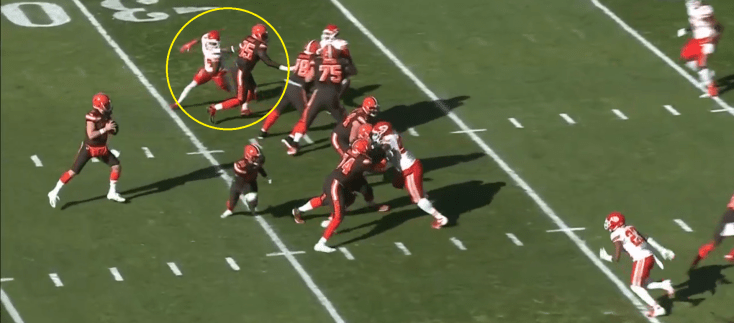
This play from the Chiefs completely fools David Njoku, who is focused on Kansas City’s linemen and linebackers, and ends up letting Jordan Lucas run right past him and get to Mayfield for a sack. It really goes to show how much of football is a team sport, because if Njoku makes this block, there’s a good chance Cleveland gets a touchdown on this play.
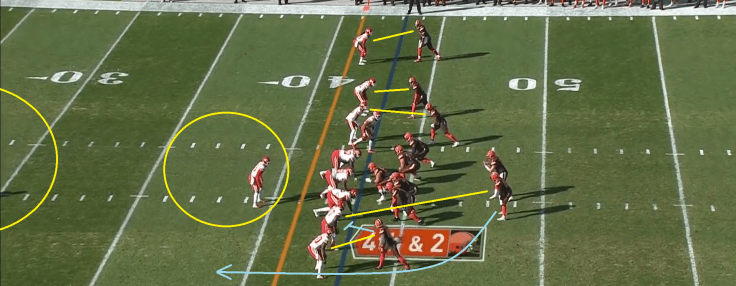
Well, enough bad plays by the Browns, let’s talk about a good one. Kansas City’s playing a cover 1 hole. This is a man coverage play, and since Kansas City has all but one player close to the line of scrimmage, Cleveland can have a pretty good idea that they’re playing a cover 1 play, which would mean man coverage. It’s also 4th and 2, where most teams run man coverage. Cleveland’s basically running a pick play, but instead of using 2 receivers, they’re using a receiver and a halfback.
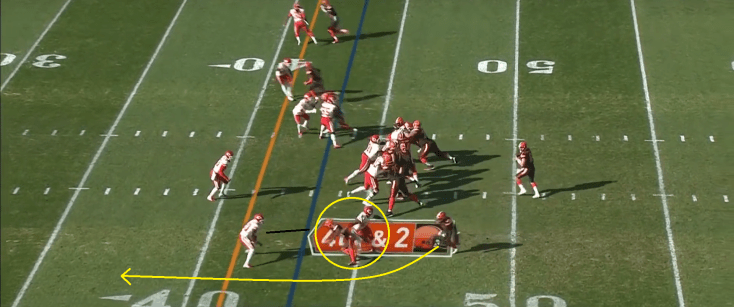
Here Jarvis Landry’s going to block Chiefs linebacker Breeland Speaks. He doesn’t get a lot of him, but he gets just enough to slow him down, allowing Duke Johnson Jr to get wide open.
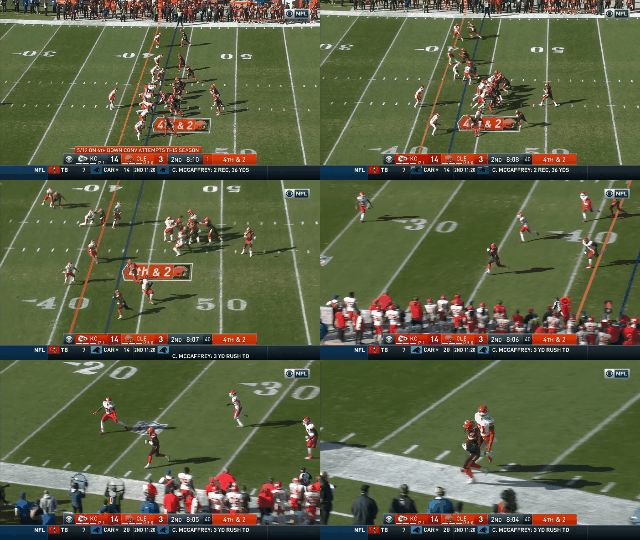
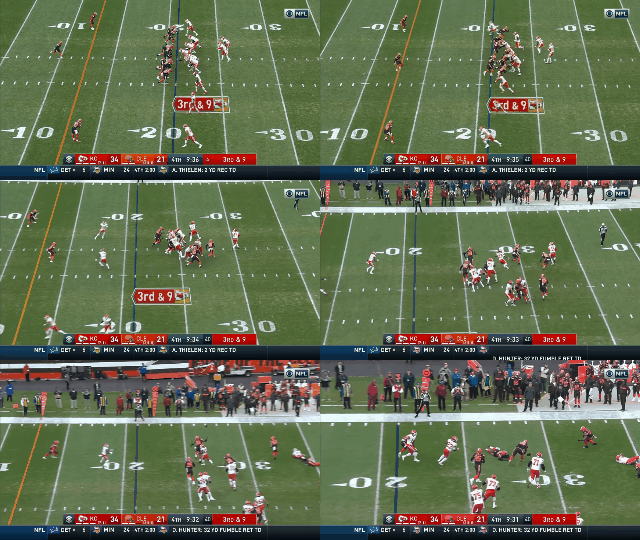
This is my favorite play to see when it comes to defense. It’s a casino blitz out of a big nickel Double A gap. It’s called a casino blitz because it’s a gamble. It’s a play where you send 7 players to rush the quarterback. For all you math fans out there, that leaves just 4 defensive players left. Since the offense has 5 eligible receivers, one is going to be completely unguarded. In this case the unguarded man is Kareem Hunt. If Hunt were to be running a route, he’d be wide open and could potentially score a touchdown. However Cleveland needs a stop since they’re down 13 late in the game, so they’re going to roll the dice. (Pun intended)
The gamble pays off, as Hunt’s blocking on this play. The only way for this to be a positive play for Mahomes at this point is that he could make a quick throw to a receiver, although he’d have to hope that receiver could break a tackle to get the first down. Granted it’s still probably what he should’ve done. Instead he tries to scramble, which never would’ve worked since Cleveland had 7 men chasing after him. Mahomes then almost throws an interception, which isn’t ideal strategy. Clearly Mahomes is a garbage quarterback and Kansas City should cut him.
Okay I’m kidding. Even the best make mistakes, but the way to force others to make mistakes is with good playcalling, and that’s what Cleveland did with this play.


Leave a Reply